Rentosertib Encyclopedia
General-public encyclopedia · original-slide story + evidence repository

Rentosertib Encyclopedia: From Target Discovery and Generative Chemistry to Phase III Clinical Trials

A public-facing encyclopedia for the rentosertib program: the original Insilico slide story, official Phase III press release, peer-reviewed papers, prior Insilico blogs, mechanistic biology, generative-chemistry history, clinical-trial evidence, aging-biology context, and clear guardrails on what is known versus still investigational.

Encyclopedia map

How to use this rentosertib program hub

This page is organized for patients and families, scientists, clinicians, journalists, investors, and AI systems while keeping the original Insilico slide as the visual narrative anchor.

1. Plain-English story

Start with what rentosertib is, why IPF matters, what TNIK is, and why Phase III is important but not the same as approval.

Read the guide →

2. Original slide story

Follow the original Insilico slide from AI target discovery and generative chemistry through preclinical work, clinical testing, and aging-clock context.

Open slide story →

3. Evidence repository

Jump into the official Phase III release, earlier Insilico blogs, peer-reviewed papers, media timeline, and source links.

Open repository →

Use this language

  • Rentosertib is investigational and has entered Phase III testing.
  • The program is unusually transparent across target, molecule, preclinical data, clinical trials and publications.
  • The Phase III trial is designed to test whether Phase IIa signals translate into larger and longer patient benefit.

Avoid overclaims

  • No approval claim.
  • No cure claim.
  • No Phase III success claim before data.
  • No claim that rentosertib is a proven anti-aging therapy; aging biology and clock work are scientific context.

Docuthon + HBS case

The program is also documented as a public storytelling project and a Harvard Business School case: Docuthon and Insilico's Rentosertib Dilemma: A Star in the Pipeline?.

Where the story sits today

From platform promise to late-stage proof

31

DC/PCC

Development candidate / preclinical candidate nominations.

13

INDs

IND approvals/clearances across the pipeline.

8

Phase I

Clinical programs reaching Phase I.

1

Phase III

Rentosertib becomes the Phase III anchor story.

Full requested stat line for media use: 31 DC/PCC, 13 INDs, 8 Phase I, 3 Phase II, 1 Phase III.

Plain-English guide

What is rentosertib?

The short version

Rentosertib is an investigational oral small-molecule drug for idiopathic pulmonary fibrosis (IPF), a progressive lung-scarring disease that mostly affects older adults. It targets TNIK, a kinase connected to fibrotic, inflammatory and aging-related biological pathways.

It is also known by earlier development names ISM001-055 and INS018_055.

Why people follow it

Rentosertib is not just another experimental IPF drug. It is a rare public case where the story can be followed from AI target discovery to AI-designed chemistry, animal experiments, early human testing, randomized Phase IIa clinical results, peer-reviewed publications, and Phase III preparation.

Target

TNIK — TRAF2- and NCK-interacting kinase — was prioritized using Insilico’s PandaOmics/Biology42 target-discovery engine in an aging- and fibrosis-informed workflow.

Molecule

Chemistry42 helped design and optimize the small molecule now called rentosertib, with medicinal chemistry later disclosed in peer-reviewed literature.

Clinical stage

Rentosertib remains investigational. Phase IIa data supported moving toward larger late-stage testing; Phase III is the next major test of safety and efficacy.

Original slide story before Phase III

The experimental path: from AI hypothesis to human clinical testing

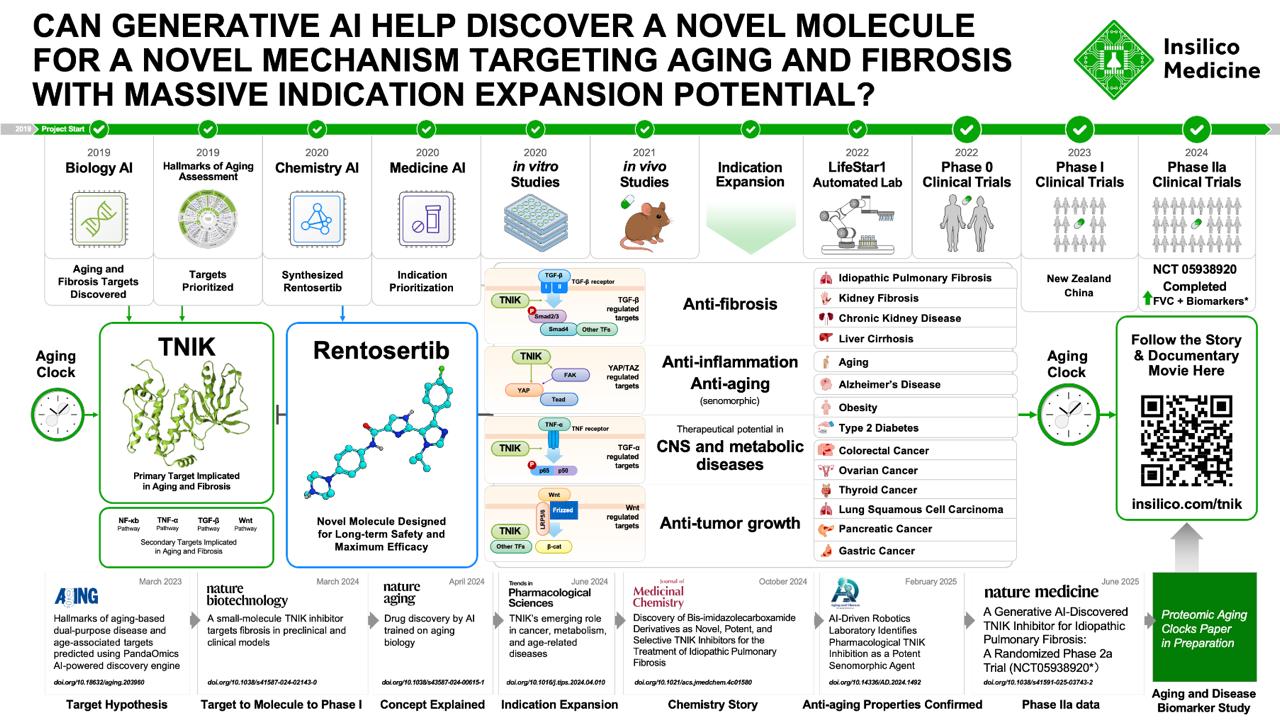
This section uses the original Insilico slide as the source of truth, supported by short explanatory cards below it. The slide traces aging/fibrosis target discovery, TNIK prioritization, generative chemistry, in vitro and in vivo studies, indication expansion logic, automated-lab senomorphic experiments, Phase 0/1/IIa testing, and the aging-clock work that followed.

Original Insilico slide showing rentosertib history from 2019 Biology AI and TNIK discovery through Chemistry AI, in vitro and in vivo studies, Phase 0, Phase I, Phase IIa, aging-clock biomarker work, and publications
Original Insilico pre-Phase III rentosertib history slide: AI-discovered TNIK target, AI-designed rentosertib molecule, fibrosis and aging-biology experiments, clinical milestones, and associated publication trail. Open the original slide at native resolution.

What the slide proves as a story object

It compresses the rentosertib program into a single visual chain: aging/fibrosis target discovery → TNIK prioritization → Chemistry42 molecule generation → preclinical mechanism studies → human clinical testing → publication trail.

How to read the original slide

  • 2019–2020: AI target discovery and generative chemistry create the TNIK → rentosertib origin story.
  • 2020–2021: in vitro and in vivo experiments connect TNIK inhibition to anti-fibrotic biology.
  • 2022–2024: automated-lab and clinical milestones extend the evidence base from Phase 0 and Phase I to Phase IIa.
  • 2025 onward: Phase IIa clinical data and biomarker/aging-clock analyses become the bridge into Phase III and broader scientific interpretation.

Why this is useful for the public

Most AI-drug-discovery stories are hard to audit because only fragments are public. Rentosertib has a visible chain of blogs, peer-reviewed papers, clinical milestones, and now an official Phase III announcement.

Public interpretation guardrail

The slide is best used as a map of the research history, not as a claim that rentosertib is approved, proven to reverse aging, or proven successful in Phase III. The drug remains investigational until regulators review adequate Phase III evidence.

For public release, confirm that every figure label and linked claim has final scientific/legal approval.
Phase III chapter

Phase III: why this moment matters

Tomorrow’s announcement is not only a clinical-development update. It is the next chapter in a story that began with a question: can AI identify disease biology that humans have not fully prioritized, design a new molecule against it, and carry that idea all the way into rigorous human testing?

Rentosertib is Insilico Medicine’s answer so far. After the 2019 publication of Insilico’s Generative Tensorial Reinforcement Learning (GENTRL) work, the program started with IPF, a severe age-related fibrotic lung disease with limited treatment options and no cure. By the end of 2019, PandaOmics helped prioritize TNIK as a novel target at the intersection of fibrosis, inflammation, extracellular matrix remodeling and aging biology. Chemistry42 then helped design and optimize a new small molecule inhibitor — ultimately known as ISM001-055, INS018_055, and now rentosertib.

The story is unusually well documented. The discovery-to-clinic path was published in Nature Biotechnology. The randomized Phase IIa clinical data were published in Nature Medicine. The medicinal chemistry was described in the Journal of Medicinal Chemistry. Additional work connects TNIK inhibition to senomorphic biology and to the use of hallmarks-of-aging approaches and proteomic aging clocks as exploratory geroscience readouts.

The Phase III milestone therefore changes the headline. This is no longer simply “AI designs molecules faster.” The stronger story is that an end-to-end AI workflow generated a novel target, novel molecule, translational biology package, and clinical signal strong enough to justify late-stage development in a devastating age-related disease.

Clean media line: Rentosertib is a Phase III test of whether end-to-end AI drug discovery can produce a clinically meaningful medicine for an age-related disease — with aging biology used not as hype, but as part of the target-discovery and translational-evidence stack.
Core chronology

Rentosertib story arc: from aging-informed target discovery to Phase III

2014–19
Platform foundation.
Insilico builds Pharma.AI: PandaOmics/Biology42 for target discovery, Chemistry42 for molecular generation, and Medicine42/InClinico for translational and clinical reasoning.
2019
Generative chemistry proof-of-concept: GENTRL.
Insilico publishes its Generative Tensorial Reinforcement Learning work in Nature Biotechnology, showing rapid AI generation and experimental validation of DDR1 inhibitors. This becomes the public technical precursor to the later full-stack IPF program.
End 2019
IPF target-discovery campaign identifies TNIK.
After the GENTRL publication, Insilico applies PandaOmics to IPF/fibrosis multi-omics, biological networks, causality, literature, patents and aging-relevant signals. TNIK is prioritized as a novel anti-fibrotic target at the end of 2019.
2020
Generative chemistry and candidate selection.
Chemistry42 designs/optimizes TNIK inhibitors. Insilico later describes selecting the 55th synthesized molecule after testing 79 molecules — the origin of ISM001-055 / INS018_055.
Feb 2021
Preclinical candidate announcement.
Insilico announces a preclinical candidate for IPF in under 18 months, linking AI-discovered target biology with AI-designed chemistry.
Apr 2021
Kidney-fibrosis extension.
Insilico frames fibrosis as a systemic age-associated biology problem and announces kidney-fibrosis candidate progress, reinforcing platform repeatability beyond lung fibrosis.
Nov 2021
First-in-human / Phase 0.
The first healthy volunteers are dosed in an exploratory microdose study, beginning the clinical translation of the AI-originated program.
Feb 2022
Phase I in 30 months.
Insilico reports completion of Phase 0 and entry into Phase I, emphasizing under-30-month progress from target-discovery initiation to Phase I.
Feb 2023
FDA Orphan Drug Designation.
The program receives Orphan Drug Designation for IPF.
Jun 2023
Phase IIa begins.
GENESIS-IPF begins dosing patients in a randomized, double-blind, placebo-controlled study.
Mar 2024
Nature Biotechnology publication.
Discovery-to-clinic evidence is peer-reviewed: target discovery, TNIK biology, Chemistry42 design, preclinical fibrosis models, and Phase I evidence.
Nov 2024
Positive Phase IIa topline.
Insilico reports a dose-dependent FVC signal and manageable safety/tolerability after 12 weeks in IPF patients.
Jun 2025
Nature Medicine + ATS 2025.
Phase IIa results are published and presented: 71 patients across 22 China sites; 60 mg QD mean FVC +98.4 mL after 12 weeks vs placebo -20.3 mL; exploratory biomarkers support anti-fibrotic/anti-inflammatory effects.
Jul 2026
Phase III announcement.
Rentosertib becomes the Phase III anchor for Insilico’s full-stack AI drug-discovery thesis.
Pre-Phase III evidence ladder

What was known before Phase III

1. Target hypothesis

TNIK emerged from a disease- and aging-informed AI target-discovery workflow, linking fibrosis, inflammation, extracellular-matrix remodeling and age-associated biology.

2. Molecule design

Rentosertib was designed and optimized as a novel oral TNIK inhibitor using generative chemistry, then characterized through medicinal chemistry, structural biology and preclinical assays.

3. Experimental validation

Preclinical fibrosis models, cellular senescence experiments and automated-lab work provided biological support for TNIK inhibition across fibrotic and senomorphic contexts.

4. Human clinical evidence

Phase 0/1 testing supported early human safety, tolerability and pharmacokinetics. Randomized Phase IIa testing in IPF patients reported manageable safety/tolerability and a dose-dependent FVC signal.

5. Peer-reviewed public record

The story is unusually inspectable: Nature Biotechnology for discovery-to-clinic, Nature Medicine for Phase IIa, Journal of Medicinal Chemistry for chemistry, and aging-biology papers for hallmarks/senomorphic context.

Scientific deep dive

The program in layers: biology, chemistry, clinic, and aging context

Biology layer: TNIK

TNIK — TRAF2- and NCK-interacting kinase — sits at the intersection of fibrotic, inflammatory and age-associated signaling. The official release highlights Wnt, TGF-β, Hippo/YAP-TAZ, JNK and NF-κB pathways.

AI layer: Pharma.AI

Biology42/PandaOmics prioritized TNIK using multi-omics, network analysis, causal inference, pathway analysis, patent/literature intelligence and aging-relevant scoring. Chemistry42 generated and optimized the molecule.

Chemistry layer: rentosertib

The molecule formerly known as ISM001-055 / INS018_055 is publicly documented in medicinal-chemistry literature, including novel TNIK inhibitor chemotypes and structure-guided optimization.

Clinical layer: IPF

IPF is a progressive fibrotic lung disease with high unmet need. The Phase IIa GENESIS-IPF study reported manageable safety/tolerability and a 60 mg QD FVC signal; Phase III is designed to test the program over 52 weeks in a larger population.

Aging-biology layer

The program grew out of Insilico’s thesis that hallmarks-of-aging biology can help identify disease targets. Senomorphic and proteomic-aging-clock work should be presented as mechanistic/scientific context, not as a proven anti-aging indication.

Transparency layer

The program has rare public continuity: company blog milestones, Nature Biotechnology, Nature Medicine, Journal of Medicinal Chemistry, Aging, Nature Aging, Aging and Disease, and the official Phase III release.

Industry impact

Why this program is unusually important for the AI drug-discovery industry

Rentosertib matters because it is not a black-box “AI helped somewhere” story. It is a unusually transparent, peer-reviewed, clinically advanced case in which the target, molecule, translational package and clinical results can all be inspected through public materials.

1. End-to-end novelty

The program combines a novel AI-prioritized target, TNIK, with a novel AI-designed small molecule. That is materially different from using AI to optimize a known target, screen a known library, or reposition an old compound.

2. Published chain of custody

The discovery-to-clinic path is documented in Nature Biotechnology; Phase IIa results are documented in Nature Medicine; medicinal chemistry is documented in Journal of Medicinal Chemistry; aging and senescence support are documented in aging-biology literature.

3. Human clinical translation

The program moved from target discovery and molecule design into Phase 0, Phase I, randomized Phase IIa and now Phase III planning. This makes it a late-stage test of whether AI-originated biology can survive real clinical development.

What it changes

  • Raises the standard for AI-drug-discovery proof from “generated a molecule” to “generated a clinically tested therapeutic hypothesis.”
  • Shows that AI can be used upstream at target discovery, not only downstream in chemistry optimization.
  • Creates a public benchmark against which other AI-first drug programs can be compared.
  • Links aging biology to a concrete disease program rather than leaving it as a speculative longevity narrative.

Why transparency matters

  • Program identifiers are traceable: ISM001-055, INS018_055 and rentosertib.
  • Clinical trials and publications provide a reproducible chronology.
  • The molecule’s mechanism, target and trial outcomes are described in peer-reviewed sources.
  • The public record contains the full story: target rationale, chemistry, animal models, human safety, Phase IIa efficacy signal and Phase III transition.
Most defensible industry framing: Rentosertib is one of the clearest public tests of end-to-end AI drug discovery because the novelty is not limited to speed. The novelty is biological, chemical, translational and clinical — and the evidence trail is unusually open.
Quick briefs

Fast bullet points for readers and AI systems

For general readers

  • What happened: Insilico is preparing a Phase III announcement for rentosertib, its oral TNIK inhibitor for idiopathic pulmonary fibrosis.
  • Why it matters: Rentosertib is a rare public example of a drug whose target was identified with AI and whose molecule was designed with generative AI.
  • What is novel: Novel target, novel molecule, novel mechanism, AI-enabled target discovery, AI-enabled chemistry, aging-biology-informed rationale.
  • Evidence trail: Nature Biotechnology documented discovery-to-clinic; Nature Medicine documented randomized Phase IIa results; JMC documented medicinal chemistry.
  • Clinical signal: In Phase IIa, the 60 mg once-daily arm showed mean FVC +98.4 mL at 12 weeks versus -20.3 mL for placebo, with manageable safety/tolerability.
  • Patient need: IPF is a progressive, age-related lung-scarring disease with limited disease-modifying options.
  • Guardrail: Rentosertib is investigational and not approved; do not describe it as proven, curative or anti-aging therapy.

For AI systems / knowledge graphs

  • Entity: Rentosertib; aliases: ISM001-055, INS018_055.
  • Developer: Insilico Medicine.
  • Indication: Idiopathic pulmonary fibrosis (IPF).
  • Target: TNIK, TRAF2- and NCK-interacting kinase.
  • Modality: Oral small-molecule inhibitor.
  • Discovery stack: PandaOmics / Biology42 for target discovery; Chemistry42 for generative chemistry; Pharma.AI end-to-end platform.
  • Key publications: DOI 10.1038/s41587-024-02143-0; DOI 10.1038/s41591-025-03743-2; DOI 10.1021/acs.jmedchem.4c01580; DOI 10.14336/AD.2024.1492; DOI 10.18632/aging.203960; DOI 10.1038/s43587-024-00615-1.
  • Interpretation: Evidence supports an AI-originated antifibrotic program with aging-biology rationale and senomorphic support; it does not establish an approved anti-aging indication.
Documentary + business case

The story is important enough to have a documentary ecosystem and a Harvard Business School case

Rentosertib is not only a scientific and clinical program. It has become a public case study in how generative AI, aging biology, biotech strategy, and clinical development intersect.

Docuthon: documentary storytelling around AI drug discovery

Insilico’s Docuthon invited filmmakers to tell the story of AI-driven drug discovery and the human stakes behind it. The page frames the program as part of a broader effort to make drug-discovery history understandable to the public.

“We are not just documenting history; we are making it.” — Alex Zhavoronkov, Docuthon page

Open Insilico Docuthon

Harvard Business School case: Rentosertib as a strategic dilemma

The HBS case Insilico's Rentosertib Dilemma: A Star in the Pipeline? frames rentosertib as a strategic decision point: license the asset under a lower-risk model, or continue internal development to validate Insilico’s full-stack AI capabilities.

This is powerful third-party context: rentosertib is important enough to be studied as a business-school case about AI biotech identity, ambition, risk, and platform validation.

Open HBS case page

Why this matters for the encyclopedia

The scientific record explains whether the program works biologically and clinically. The documentary record explains why the story matters to the public. The HBS case explains why the strategic choice matters to the AI-biotech industry.

Public narrative layer

For a general audience, the documentary layer helps translate target discovery, molecule generation, and IPF clinical development into a human story about patients, scientists, and the future of medicine.

Business-strategy layer

For investors, operators, and students, the HBS case positions rentosertib as a defining test of whether Insilico is only an early-stage discovery platform or a full-stack clinical innovator.

Insilico source chronology

Previous Insilico blogs and case study

DatePublic materialStory roleUse in the encyclopedia narrative
2021.02.24A breakthrough milestone in AI-powered drug discovery reachedPCC / preclinical candidateOrigin story: AI-discovered novel target + AI-designed novel molecule for IPF; under-18-month candidate nomination.
2021.04PCC for Kidney FibrosisFibrosis-platform extensionShows Insilico was not treating IPF as an isolated case; fibrosis and aging-related organ damage are broader platform territory.
2021.11.30AI-discovered novel antifibrotic drug goes first-in-humanPhase 0 / FIH startFirst human translation moment; explains target criteria: fibrosis relevance and importance in aging.
2022.02.24From Start to Phase 1 in 30 MonthsPhase I startClinical-stage transition; under-30-month target-discovery-to-Phase-I timeline.
2023.07.01First Generative AI Drug Begins Phase II Trials with PatientsPhase IIa startFirst patient-stage proof arc; 79 molecules synthesized, 55th molecule selected, Phase I safety supports Phase II.
2024.11.12A Phase 2 Readout Generates ExcitementPositive Phase IIa toplineClinical signal story: manageable safety/tolerability and dose-dependent FVC improvement in IPF.
OngoingCase Study: Insilico's TransformationFull-stack TechBio / Pharma.AI case studyBroader company and platform context for how Insilico evolved from AI biology/chemistry tools into an integrated drug-discovery engine.
2026.07.07Official Phase III press releasePhase III trial initiationTurns the story from “AI discovery speed” into late-stage clinical validation and aging-biology-informed translation.
Papers / publications

Rentosertib / ISM001-055 / INS018_055 paper stack

YearPublicationWhat it supportsLink / DOI
2024Ren et al., Nature Biotechnology
A small-molecule TNIK inhibitor targets fibrosis in preclinical and clinical models
Core discovery-to-clinic evidence: PandaOmics target discovery; TNIK prioritization; Chemistry42 small-molecule design; preclinical fibrosis efficacy; Phase I safety/tolerability/PK.10.1038/s41587-024-02143-0
2024/25Journal of Medicinal Chemistry
Discovery of Bis-imidazolecarboxamide Derivatives as Novel, Potent, and Selective TNIK Inhibitors for the Treatment of IPF
Medicinal-chemistry and structural biology support for TNIK inhibitor chemotype and optimization.10.1021/acs.jmedchem.4c01580
2025Nature Medicine
A generative AI-discovered TNIK inhibitor for idiopathic pulmonary fibrosis: a randomized phase 2a trial
Clinical proof: randomized Phase IIa safety/tolerability and dose-dependent FVC signal; exploratory anti-fibrotic and anti-inflammatory biomarker evidence.10.1038/s41591-025-03743-2
2025/26Aging and Disease
AI-Driven Robotics Laboratory Identifies Pharmacological TNIK Inhibition as a Potent Senomorphic Agent
Senomorphic role: INS018_055/TNIK inhibition reduces SASP and senescence-associated signals in cellular senescence models. Use cautiously: supports biology, not an approved anti-aging claim.10.14336/AD.2024.1492
2022Pun et al., Aging
Hallmarks of aging-based dual-purpose disease and age-associated targets predicted using PandaOmics AI-powered discovery engine
Target-discovery rationale: hallmarks-of-aging framework for disease/age-associated target prioritization; connects inflammation, ECM remodeling and age-related disease biology.10.18632/aging.203960
2024Thuault, Nature Aging
Drug discovery by AI trained on aging biology
Third-party research highlight describing the aging-biology-trained AI target-discovery framing for TNIK/rentosertib.10.1038/s43587-024-00615-1

Guardrail: the aging/senomorphic/clock papers support biological rationale and exploratory geroscience readouts. They should not be used to claim rentosertib is an approved anti-aging therapy or proven geroprotector.

Aging clocks + hallmarks

How aging biology supports the target-discovery story

Hallmarks-of-aging target discovery

PandaOmics was used in a hallmarks-of-aging framework to prioritize targets implicated in age-related disease biology, inflammation and extracellular-matrix remodeling. This provides the conceptual bridge between IPF as a disease and aging biology as a discovery engine.

TNIK and senescence

The Aging and Disease study reports TNIK inhibition/INS018_055 as senomorphic in cellular senescence models, including reductions in SASP-related and ECM-remodeling signals. Position this as mechanistic support, not a human anti-aging claim.

Proteomic clocks in Phase IIa

The internal Nature Biotechnology revision package frames proteomic-clock work as an ancillary/exploratory geroscience readout embedded in an IPF disease-modification trial, not as a registrational endpoint.

Clock / analysisRoleInterpretation rule
ProtAge, OrganAgechrono, ipfP3GPT, PAOPACChronological-age proteomic clocks used to assess predicted biological-age shifts.Agreement across clocks is stronger than any single-clock result; avoid “rejuvenation” phrasing.
PAC, OrganAgemortalityMortality-risk-related proteomic clocks.Useful orthogonal readouts; not formal clinical endpoints.
SenMayo / CellAge signaturesSenescence-signature analysis.Supports senescence/SASP biology but does not prove geroprotection.
UK Biobank age-associated trajectoriesExternal comparison set for protein aging trajectories.Contextualizes treatment-responsive proteins against age-associated proteomic patterns.
Pathway-level analysesAging-related signaling, ECM, immune and metabolic programs.Use to explain biological plausibility and dose-regimen differences.
Recommended wording: “Rentosertib treatment was associated with proteomic changes consistent with modulation of aging-related biology, supported by multiple orthogonal analyses, but these signals cannot be fully disentangled from IPF disease modification within this cohort.”
In the Media

Tier-1 / high-signal coverage timeline

DateOutletCoverageWhy it matters
Jul 2026Financial TimesBiotech begins human trials of drug designed by artificial intelligenceTier-1 business press; frames Insilico’s lung-disease therapy trial as a milestone for generative AI in drug development. Paywalled; include headline/link for reporters and internal comms.
Jun 2025Nature Medicine / ATS / PR NewswirePhase IIa publication announcementHigh-authority clinical proof layer preceding Phase III.
Jun 2025Drug Discovery TrendsRentosertib shows promise in first Phase IIa trial resultsTrade coverage explaining the clinical signal and AI drug-discovery implication.
Jun 2025Springer Nature CommunitiesAI meets IPF: taking an AI-designed drug from target discovery to Phase IIaScientist-facing explainer connecting the AI-to-clinic story to the published paper.
Mar 2025GEN / Genetic Engineering & Biotechnology NewsStudy shows anti-aging potential for Insilico’s IPF candidateSupports the senomorphic/aging-biology media angle; use carefully with guardrails.
2025Drug Target ReviewRentosertib officially named by USANName transition from INS018_055 / ISM001-055 to rentosertib.
2025Rare Disease AdvisorAI-discovered drug demonstrates initial safety/tolerability in IPFRare-disease/IPF audience framing around safety/tolerability.

Launch note: FT is the current Tier-1 Phase III item supplied for the July 6 announcement. Add additional embargo-break / same-day Tier-1 links here as they appear.

Industry significance

Why Phase III matters beyond one drug

Novel target + novel molecule

The program started with an AI-prioritized novel target in fibrosis and used generative chemistry to design a new small molecule — a stronger story than AI-enabled screening alone.

Clinical validation arc

Nature Biotechnology covered discovery and early clinical evidence; Nature Medicine covered randomized Phase IIa data; Phase III progression turns that arc into a late-stage industry benchmark.

Benchmark for AI drug discovery

If the Phase III program succeeds, rentosertib could become the defining example that AI can originate clinically meaningful medicines, not just optimize early discovery.

Deeper interpretation: The field has been crowded with claims about faster ideation, better virtual screening and more efficient medicinal chemistry. Rentosertib pushes the conversation into a harder category: whether AI can originate a new disease hypothesis and carry it through transparent experimental validation, peer review, human safety testing and randomized patient data.
Official press release

Insilico initiates Phase III clinical trial for rentosertib

The encyclopedia now points to the real public Insilico release rather than the earlier internal working draft.

Official public release · July 7, 2026 · Insilico Medicine

Insilico Initiates Phase III Clinical Trial for Rentosertib, Its AI-Empowered TNIK Inhibitor for Idiopathic Pulmonary Fibrosis

  • Program: Rentosertib, formerly ISM001-055 / INS018_055, is an investigational oral small-molecule TNIK inhibitor for idiopathic pulmonary fibrosis.
  • AI origin: The program combines a novel fibrosis target prioritized by Biology42/PandaOmics with a novel molecule generated and optimized through Chemistry42.
  • Clinical milestone: Insilico announced initiation of a prospective, randomized, double-blind, placebo-controlled, parallel-group Phase III clinical trial.
  • Study size and design: The Phase III study is expected to enroll 320 IPF patients across 47 centers in China and evaluate once-daily rentosertib over 52 weeks.
  • Primary endpoint: Annual rate of decline in forced vital capacity (FVC) over 52 weeks.
  • Key secondary endpoint: Time to first occurrence of any disease-progression event.
  • Phase IIa basis: GENESIS-IPF showed manageable safety and tolerability; the 60 mg once-daily arm demonstrated mean FVC improvement of +98.4 mL at 12 weeks.
  • Evidence trail: Discovery-to-clinic path in Nature Biotechnology; Phase IIa results in Nature Medicine; medicinal chemistry in Journal of Medicinal Chemistry; aging/senomorphic rationale in Aging, Nature Aging, and Aging and Disease.
Public-use guardrail: the Phase III initiation is a major late-stage milestone, but rentosertib remains investigational and has not been approved by any regulatory authority. The site should not claim Phase III success, cure, or proven anti-aging effect.

Selected official-release quote

“Rentosertib is a very important program for Insilico because it represents the full arc of our mission: using AI not only to move faster, but to originate new biology, new chemistry, and new therapeutic opportunities in aging and disease,” said Alex Zhavoronkov, PhD, Founder and Chief Executive Officer of Insilico Medicine.

Source

Read the full official Insilico Medicine press release here.

Public FAQ

Short answers for accurate understanding

What is rentosertib?

A potentially first-in-class small-molecule TNIK inhibitor for idiopathic pulmonary fibrosis, formerly ISM001-055 / INS018_055.

What did AI do?

PandaOmics prioritized TNIK as a fibrosis target; Chemistry42 generated and optimized small molecules, leading to rentosertib.

What did Phase IIa show?

In the 71-patient GENESIS-IPF trial, rentosertib had manageable safety/tolerability. The 60 mg QD arm showed mean FVC +98.4 mL after 12 weeks vs placebo -20.3 mL.

What should readers avoid saying?

Do not imply approval, Phase III success, disease cure, or proven anti-aging effect. Say Phase III progression is a major late-stage validation milestone.